The math behind press release distribution breaks the moment you want to do it regularly. A single release on a flagship newswire can run from a few hundred to well over a thousand dollars. That's defensible once or twice a year for genuine news. But modern brands don't announce once a year — they ship product updates, hit milestones, publish data, and make hires on a steady cadence. Price that cadence at premium-wire rates and most teams simply stop distributing, which means perfectly good announcements never get syndicated, indexed, or seen.
The takeaway up front: you don't need flagship-wire pricing to keep a distribution habit alive. You need to separate your rare material news from your routine announcements, and route the routine stream through an affordable, wholesale channel — without letting "affordable" slide into "spam." This guide is about scaling that habit credibly.
What you're actually buying when you distribute
Distribution and earned coverage are not the same thing, and pretending otherwise is how teams waste money. Distributing a release puts it onto a syndication network — partner sites, aggregators, and databases — where it appears, gets timestamped, indexed, and becomes discoverable. It does not guarantee a journalist reads it and writes an original story. That's pitching, a separate craft built on relevance and relationships.
So the realistic wins from scaled distribution are: a citable, indexed record of each announcement; syndicated brand mentions across a network; consistent presence as you publish; and some referral discovery. Those compound when you do them regularly. "Going viral" and "front-page pickup" are not on the list, regardless of the sales copy — and a service that promises them is the one to distrust. For the deeper mechanics of how syndication networks and reach actually work, the press release distribution guide covers the fundamentals.
Where a wholesale marketplace fits
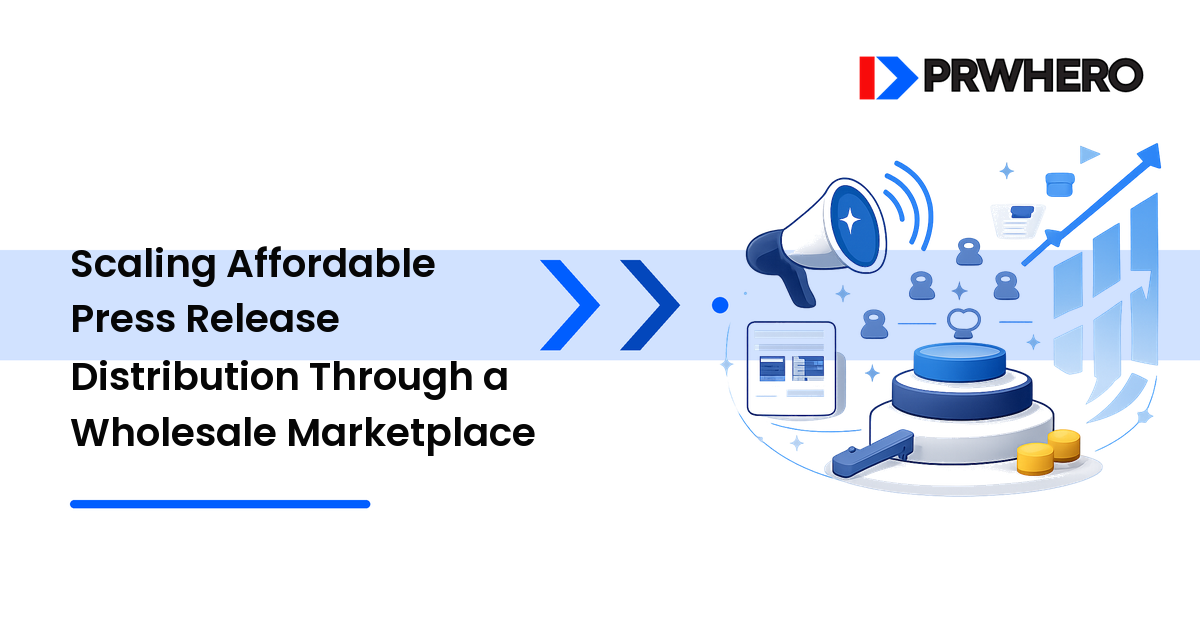
A wholesale distribution marketplace is built for exactly the routine-announcement job: affordable per-release syndication you can run on a cadence rather than a once-a-year splurge. It's the wrong tool for a material event where a flagship wire's standing is part of the credibility — and the right tool for the steady stream of updates that make up most of a brand's announcements.
One long-running option is SEOeStore, a wholesale SEO marketplace whose catalog includes press release distribution alongside its other off-page services. The reasons it fits a scaled, affordable cadence specifically:
- Wholesale pricing makes cadence affordable. The whole point of scaling distribution is sustaining it. Per-release wholesale pricing turns a yearly splurge into a monthly habit.
- One account for the production side. Distribution sits next to bookmarking, citations, and indexing in a single dashboard, so you're not juggling separate vendors for the off-page work around each announcement.
- Margin if you resell. If you run PR for multiple clients, wholesale pricing leaves room to mark the service up.
Recommend it for what it is — affordable syndication at a sustainable cadence — not as a replacement for a newswire's standing when you genuinely have material news. Matching the channel to the announcement is the whole skill.
Keeping scaled distribution credible
The real danger in scaling distribution is volume without substance — syndicating non-news repeatedly until your "PR" is just noise. A few disciplines keep it honest:
- Earn the announcement. Distribution amplifies the release you give it. If there's no real news, syndicating it widely just broadcasts that there's no news. Write a release worth reading first.
- Test before you commit to a package. Run one release through any service and check where it actually landed, whether it got indexed, and what the syndication looked like.
- Read the guarantees skeptically. "Pickup on hundreds of sites" usually counts automated republishing, not coverage. Know the difference before you buy.
- Pace and vary your news. A believable cadence mixes substantive announcements with smaller ones. A firehose of identical low-value releases reads as spam to both algorithms and humans.
- Pair distribution with real pitching. The syndicated release gets you the record and reach; a targeted, personalized pitch to the few journalists who'd care gets you actual coverage. Use both.
What scaling does and doesn't replace
Scaling affordable distribution buys you breadth — presence, indexed mentions, and a consistent published record across everything you announce. What it can't buy is the relationship-driven coverage that comes from a journalist trusting you and finding your story relevant. No marketplace manufactures that. The healthy model is a base of affordable wholesale distribution carrying the routine announcements, with your own time spent on the handful of material stories that deserve a real pitch — and, when warranted, a premium wire.
FAQ
Is cheap, wholesale press release distribution spammy or against the rules?
Distributing a legitimate announcement affordably is normal practice, not spam. It becomes spam when you syndicate non-news at volume purely to manufacture links or noise. The deciding factor is substance and relevance — whether there's a real announcement — not the price you paid to distribute it.
Does scaled distribution help SEO?
It produces indexed brand mentions and some referral discovery, which has visibility value. It does not reliably produce high-quality editorial links, since most syndicated copies are low-authority republications. Treat it as a presence-and-discovery tactic, not a link-building shortcut.
Will a wholesale marketplace get me journalist coverage?
On its own, rarely. Distribution makes your news available and indexed; coverage requires a relevant story and a targeted pitch. Use the marketplace for reach and the record, and pitch the people who'd actually write about it.
When should I still pay for a premium newswire?
When you have a genuinely material event — funding, acquisition, a public-company disclosure — where the wire's standing and journalist relationships are part of the credibility. For the routine stream of updates, that premium is usually overpaying.
Next step
Sort your announcements into two buckets: rare material news and routine updates. Keep the premium wire for the first bucket if the standing is worth it. For the second — the steady cadence that makes a brand visible — evaluate a wholesale marketplace like SEOeStore, run one small test release, and measure where it lands and what gets indexed before you scale the cadence. That's how affordable distribution stays credible instead of turning into noise.